
Common Rat and Mouse Species in Glen Ellyn, IL- Signs, Identification, Diseases & Damage
Not every rodent problem in Glen Ellyn looks the same, and that is because it usually is not the same animal. Four species cause nearly every call in this part of DuPage County: Norway rats, roof rats, house mice, and deer mice. Each one behaves differently, prefers different parts of a home, and carries different health risks. Knowing which one you are actually dealing with is the first real step toward solving the problem instead of guessing.
- 100+ Reviews
- Licensed & Certified
- Established 2016
- Same/Next-Day Service
Why Rodent Identification Matters in Glen Ellyn Homes
A trap or seal point that works for one species often fails for another. Norway rats stay low and burrow near foundations, while roof rats climb into attics. House mice squeeze through gaps near kitchens and utility lines, while deer mice tend to come in from wooded or grassy areas outside. Glen Ellyn’s older housing stock plays a role here too. Many homes in town, including streets near the Glen Ellyn Public Library and Baker Memorial United Methodist Church downtown, were built decades ago, and original sill plates and aging foundations give any of these four species a way inside if the signs go unnoticed.
Norway Rats
Norway rats are the most common rat species found in Glen Ellyn. They are stocky, brown or gray, and typically seven to ten inches long, not counting the tail, which is shorter than their body length. Their ears and eyes are relatively small for their size, and their nose is blunt rather than pointed.
Signs: Look for burrow holes near foundations, sheds, or compost piles, along with greasy rub marks along walls where rats travel repeatedly. Droppings are roughly three-quarters of an inch long with blunt, rounded ends.
Identification: Norway rats stay close to the ground. If you are hearing movement in a basement, crawl space, or garage rather than the attic, a Norway rat is the more likely cause.

Roof Rats
Roof rats, also called black rats, are slimmer than Norway rats, with larger ears and eyes, and a tail that is longer than their body. They are less common in Glen Ellyn than Norway rats but do turn up in homes with dense tree cover, including areas along the Illinois Prairie Path.
Signs: Roof rats nest higher than Norway rats, often in attics, soffits, or dense shrubs, so noise usually comes from above rather than below. Droppings are slightly smaller than a Norway rat’s, with more pointed ends.
Identification: If activity is concentrated in the attic rather than the basement or crawl space, and the home is near heavy tree cover, roof rats are worth ruling in before assuming it is a Norway rat.
House Mice
House mice are the most common rodent call in Glen Ellyn overall. They are small, gray or light brown, with a body around two and a half to three and a half inches long and a thin, mostly hairless tail.
Signs: Droppings are small, about the size of a grain of rice, with pointed ends, usually found near food storage, under sinks, or along baseboards. Gnaw marks on cardboard or wood trim are also common.
Identification: House mice stay close to food sources and rarely travel far from a reliable nest site, which is why activity is usually concentrated in kitchens, pantries, and nearby storage areas.

Deer Mice
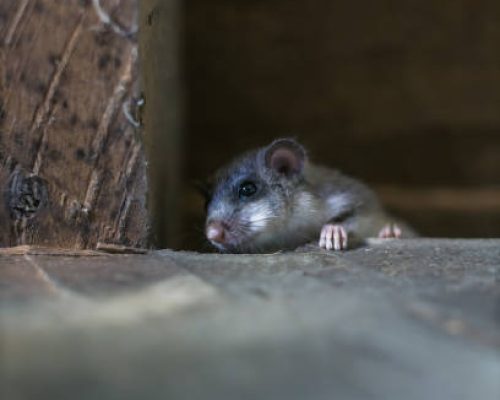
Deer mice look similar to house mice at first glance but have one clear difference: a sharply two-toned tail, white underneath and brown on top. Their eyes and ears are also noticeably larger relative to their head than a house mouse’s.
Signs: Deer mice are more likely to show up in basements, garages, and crawl spaces near the exterior wall than in kitchens, since they typically come in from fields or wooded areas rather than being drawn by food.
Identification: The tail color is the fastest way to tell a deer mouse from a house mouse. This distinction matters beyond curiosity, since deer mice are the primary carrier of hantavirus in North America, according to the Centers for Disease Control and Prevention, which changes how droppings from this species should be handled during cleanup.
- Only Rodent Focus
- Top-rated
- Photo Report
- Affordable Services
Species Comparison
| Features | Norway Rats | Roof Rats | House Mice | Deer Mice |
|---|---|---|---|---|
| Body Length | 7 to 9 inches | 6 to 8 inches | 3 to 4 inches | 2 to 4 inches |
| Tail Size | 5 to 8 inches | 7 to 10 inches | 2 to 3 inches | 2 to 5 inches |
| Color | Grayish brown to reddish brown | Dark brown to sooty black | Grey to light brown | Reddish brown to sandy |
| Diseases | Leptospirosis and Salmonellosis | Leptospirosis and Rat Bite Fever | Lymphocytic Choriomeningitis and Salmonellosis | Sin Nombre and Hantavirus |
| Minimum Entry Gap | ½ inch | ½ inch | ¼ inch | ¼ inch |
| Glen Ellyn Prevalence | Very High | Very Rare | High in Fall Season | High in Fall Season with Hantavirus Risk |
| Living Area | Basements and Crawl Spaces | Attics and Rooflines | Wall Voids, Kitchens and Crawl Spaces | Garages, Attics and Crawl Spaces |
Diseases Rodents Can Spread in Glen Ellyn Homes
All four species can pose health risks, though the specifics vary. The CDC notes that rodents in general can carry salmonella, which spreads through contact with droppings or contaminated food surfaces. Norway rats and roof rats are also linked to leptospirosis and rat bite fever, both spread through contact with urine, droppings, or bites. Deer mice carry the added risk of hantavirus, a serious respiratory illness spread by inhaling airborne particles from droppings, urine, or nesting material. Because of this, health guidance treats all rodent droppings the same way regardless of species: wetting them with disinfectant before cleanup, never dry sweeping or vacuuming, which can release particles into the air.
Structural Damage Rodents Cause in Glen Ellyn Homes
Beyond health risks, all four species chew. Rodent teeth grow continuously, so gnawing is a constant behavior, not an occasional one. The National Pest Management Association has linked rodent activity to house fires caused by chewed electrical wiring inside walls and attics. Insulation is another common target, both chewed for nesting material and compressed by tunneling, which can lower its effectiveness well before any damage is visible from the surface. Wood framing, doorframes, and stored belongings in garages or basements are also common casualties once a rodent has established a nest nearby.
How many species of rodents are there?
Worldwide, scientists have documented more than 2,600 rodent species, making up roughly 40 percent of all mammal species on Earth. In Glen Ellyn specifically, though, nearly every call comes down to just four: Norway rats, roof rats, house mice, and deer mice.
How long is hantavirus active in rodent droppings?
This is less settled than many sources suggest. The CDC’s own technical guidance states that survival time depends on temperature, humidity, and sunlight exposure, and is not precisely established. Commonly cited estimates put viability at two to three days at room temperature, but cooler, dry, shaded conditions may allow the virus to remain active for a couple of weeks. Because of this uncertainty, safe cleanup guidance treats all droppings the same regardless of how old they appear, wetting them with disinfectant before any contact rather than assuming older droppings are automatically safe.
What month are mice most active?
In Glen Ellyn, activity typically increases in September and October as temperatures start to drop, and peaks in November once DuPage County sees its first hard freeze and rodents move indoors for the winter.